Skip to main content
Contents Dark Mode Prev Up Next \(\newcommand{\markedPivot}[1]{\boxed{#1}}
\newcommand{\IR}{\mathbb{R}}
\newcommand{\IC}{\mathbb{C}}
\renewcommand{\P}{\mathcal{P}}
\renewcommand{\Im}{\operatorname{Im}}
\newcommand{\RREF}{\operatorname{RREF}}
\newcommand{\vspan}{\operatorname{span}}
\newcommand{\setList}[1]{\left\{#1\right\}}
\newcommand{\setBuilder}[2]{\left\{#1\,\middle|\,#2\right\}}
\newcommand{\unknown}{\,{\color{gray}?}\,}
\newcommand{\drawtruss}[2][1]{
\begin{tikzpicture}[scale=#1, every node/.style={scale=#1}]
\draw (0,0) node[left,magenta]{C} --
(1,1.71) node[left,magenta]{A} --
(2,0) node[above,magenta]{D} -- cycle;
\draw (2,0) --
(3,1.71) node[right,magenta]{B} --
(1,1.71) -- cycle;
\draw (3,1.71) -- (4,0) node[right,magenta]{E} -- (2,0) -- cycle;
\draw[blue] (0,0) -- (0.25,-0.425) -- (-0.25,-0.425) -- cycle;
\draw[blue] (4,0) -- (4.25,-0.425) -- (3.75,-0.425) -- cycle;
\draw[thick,red,->] (2,0) -- (2,-0.75);
#2
\end{tikzpicture}
}
\newcommand{\trussNormalForces}{
\draw [thick, blue,->] (0,0) -- (0.5,0.5);
\draw [thick, blue,->] (4,0) -- (3.5,0.5);
}
\newcommand{\trussCompletion}{
\trussNormalForces
\draw [thick, magenta,<->] (0.4,0.684) -- (0.6,1.026);
\draw [thick, magenta,<->] (3.4,1.026) -- (3.6,0.684);
\draw [thick, magenta,<->] (1.8,1.71) -- (2.2,1.71);
\draw [thick, magenta,->] (1.6,0.684) -- (1.5,0.855);
\draw [thick, magenta,<-] (1.5,0.855) -- (1.4,1.026);
\draw [thick, magenta,->] (2.4,0.684) -- (2.5,0.855);
\draw [thick, magenta,<-] (2.5,0.855) -- (2.6,1.026);
}
\newcommand{\trussCForces}{
\draw [thick, blue,->] (0,0) -- (0.5,0.5);
\draw [thick, magenta,->] (0,0) -- (0.4,0.684);
\draw [thick, magenta,->] (0,0) -- (0.5,0);
}
\newcommand{\trussStrutVariables}{
\node[above] at (2,1.71) {\(x_1\)};
\node[left] at (0.5,0.866) {\(x_2\)};
\node[left] at (1.5,0.866) {\(x_3\)};
\node[right] at (2.5,0.866) {\(x_4\)};
\node[right] at (3.5,0.866) {\(x_5\)};
\node[below] at (1,0) {\(x_6\)};
\node[below] at (3,0) {\(x_7\)};
}
\newcommand{\N}{\mathbb N}
\newcommand{\Z}{\mathbb Z}
\newcommand{\Q}{\mathbb Q}
\newcommand{\R}{\mathbb R}
\DeclareMathOperator{\arcsec}{arcsec}
\DeclareMathOperator{\arccot}{arccot}
\DeclareMathOperator{\arccsc}{arccsc}
\newcommand{\tuple}[1]{\left\langle#1\right\rangle}
\newcommand{\lt}{<}
\newcommand{\gt}{>}
\newcommand{\amp}{&}
\definecolor{fillinmathshade}{gray}{0.9}
\newcommand{\fillinmath}[1]{\mathchoice{\colorbox{fillinmathshade}{$\displaystyle \phantom{\,#1\,}$}}{\colorbox{fillinmathshade}{$\textstyle \phantom{\,#1\,}$}}{\colorbox{fillinmathshade}{$\scriptstyle \phantom{\,#1\,}$}}{\colorbox{fillinmathshade}{$\scriptscriptstyle\phantom{\,#1\,}$}}}
\)
Section 3.3 Graphs of Linear Equations (LF3)
Objectives
Graph a line given its equation or some combination of characteristics, such as points on the graph, a table of values, the slope, or the intercepts.
Subsection 3.3.1 Activities
Activity 3.3.1 .
(a) Draw a line that goes through the point
\((1,4)\text{.}\)
Diagram Exploration Keyboard Controls
Key
Action
Enter, A
Activate keyboard driven exploration
B
Activate menu driven exploration
Escape
Leave exploration mode
Cursor down
Explore next lower level
Cursor up
Explore next upper level
Cursor right
Explore next element on level
Cursor left
Explore previous element on level
X
Toggle expert mode
W
Extra details if available
Space
Repeat speech
M
Activate step magnification
Comma
Activate direct magnification
N
Deactivate magnification
Z
Toggle subtitles
C
Cycle contrast settings
T
Monochrome colours
L
Toggle language (if available)
K
Kill current sound
Y
Stop sound output
O
Start and stop sonification
P
Repeat sonification output
(b)
Was this the only possible line that goes through the point \((1,4)\text{?}\)
No. There is exactly one more line possible.
No. There are a lot of lines that go through
\((1,4)\text{.}\)
No. There are an infinite number of lines that go through
\((1,4)\text{.}\)
Answer .
(Though C is also true. D is just more descriptive.)
(c) Now draw a line that goes through the points
\((1,4)\) and
\((-3,-2)\text{.}\)
Diagram Exploration Keyboard Controls
Key
Action
Enter, A
Activate keyboard driven exploration
B
Activate menu driven exploration
Escape
Leave exploration mode
Cursor down
Explore next lower level
Cursor up
Explore next upper level
Cursor right
Explore next element on level
Cursor left
Explore previous element on level
X
Toggle expert mode
W
Extra details if available
Space
Repeat speech
M
Activate step magnification
Comma
Activate direct magnification
N
Deactivate magnification
Z
Toggle subtitles
C
Cycle contrast settings
T
Monochrome colours
L
Toggle language (if available)
K
Kill current sound
Y
Stop sound output
O
Start and stop sonification
P
Repeat sonification output
Answer .
Just the one possible line.
(d)
Was this the only possible line that goes through the points \((1,4)\) and \((-3,-2)\text{?}\)
No. There is exactly one more line possible.
No. There are a lot of lines that go through
\((1,4)\) and
\((-3,-2)\text{.}\)
No. There are an infinite number of lines that go through
\((1,4)\) and
\((-3,-2)\text{.}\)
Answer .
(Discussion could include that we would have to make the line curve to connect the points in more than one way. But, a line has to have the same slope everywhere.)
Activity 3.3.3 .
(a) Graph the line containing the points
\((-7,1)\) and
\((6,-2)\text{.}\)
Answer .
Diagram Exploration Keyboard Controls
Key
Action
Enter, A
Activate keyboard driven exploration
B
Activate menu driven exploration
Escape
Leave exploration mode
Cursor down
Explore next lower level
Cursor up
Explore next upper level
Cursor right
Explore next element on level
Cursor left
Explore previous element on level
X
Toggle expert mode
W
Extra details if available
Space
Repeat speech
M
Activate step magnification
Comma
Activate direct magnification
N
Deactivate magnification
Z
Toggle subtitles
C
Cycle contrast settings
T
Monochrome colours
L
Toggle language (if available)
K
Kill current sound
Y
Stop sound output
O
Start and stop sonification
P
Repeat sonification output
(b) Graph the line containing the points
\((-3,0)\) and
\((0,8)\text{.}\)
Answer .
Diagram Exploration Keyboard Controls
Key
Action
Enter, A
Activate keyboard driven exploration
B
Activate menu driven exploration
Escape
Leave exploration mode
Cursor down
Explore next lower level
Cursor up
Explore next upper level
Cursor right
Explore next element on level
Cursor left
Explore previous element on level
X
Toggle expert mode
W
Extra details if available
Space
Repeat speech
M
Activate step magnification
Comma
Activate direct magnification
N
Deactivate magnification
Z
Toggle subtitles
C
Cycle contrast settings
T
Monochrome colours
L
Toggle language (if available)
K
Kill current sound
Y
Stop sound output
O
Start and stop sonification
P
Repeat sonification output
(c) Graph the line given by the table below.
\(-3\) \(-12\)
\(-2\) \(-9\)
\(-1\) \(-6\)
\(0\) \(-3\)
\(1\) \(0\)
\(2\) \(3\)
Answer .
Diagram Exploration Keyboard Controls
Key
Action
Enter, A
Activate keyboard driven exploration
B
Activate menu driven exploration
Escape
Leave exploration mode
Cursor down
Explore next lower level
Cursor up
Explore next upper level
Cursor right
Explore next element on level
Cursor left
Explore previous element on level
X
Toggle expert mode
W
Extra details if available
Space
Repeat speech
M
Activate step magnification
Comma
Activate direct magnification
N
Deactivate magnification
Z
Toggle subtitles
C
Cycle contrast settings
T
Monochrome colours
L
Toggle language (if available)
K
Kill current sound
Y
Stop sound output
O
Start and stop sonification
P
Repeat sonification output
(d)
Let’s say you are given a table that listed six points that are on the same line. How many of those points are necessary to use to graph the line?
You need to plot all six points.
You can use however many you want.
Answer .
Discussion could include pointing out that only two are
necessary , but we can include more if we want. Also, including more is a good way to catch an error in plotting. One will stick out!
Activity 3.3.5 .
A line has a slope of
\(-\dfrac{1}{3}\) and its
\(y\) -intercept is
\(4\text{.}\)
(a)
We were given the \(y\) -intercept. What point does that correspond to?
\(\displaystyle (4,0)\)
\(\displaystyle (0,4)\)
\(\displaystyle \left(4,-\dfrac{1}{3}\right)\)
\(\displaystyle \left(-\dfrac{1}{3},4\right)\)
(b)
After we plot the \(y\) -intercept, how can we use the slope to find another point?
Start at the \(y\) -intercept, then move up one space and to the left three spaces to find another point.
Start at the \(y\) -intercept, then move up one space and to the right three spaces to find another point.
Start at the \(y\) -intercept, then move down one space and to the left three spaces to find another point.
Start at the \(y\) -intercept, then move down one space and to the right three spaces to find another point.
(c) Graph the line that has a slope of
\(-\dfrac{1}{3}\) and its
\(y\) -intercept is
\(4\text{.}\)
Answer .
Diagram Exploration Keyboard Controls
Key
Action
Enter, A
Activate keyboard driven exploration
B
Activate menu driven exploration
Escape
Leave exploration mode
Cursor down
Explore next lower level
Cursor up
Explore next upper level
Cursor right
Explore next element on level
Cursor left
Explore previous element on level
X
Toggle expert mode
W
Extra details if available
Space
Repeat speech
M
Activate step magnification
Comma
Activate direct magnification
N
Deactivate magnification
Z
Toggle subtitles
C
Cycle contrast settings
T
Monochrome colours
L
Toggle language (if available)
K
Kill current sound
Y
Stop sound output
O
Start and stop sonification
P
Repeat sonification output
Activity 3.3.6 .
A line is given by the equation
\(y=-2x+5\text{.}\)
(a)
What form is the equation given in?
Standard form
Point-slope form
Slope-intercept form
The form it is in doesn’t have a name.
(b)
The form gives us one point right away: the \(y\) -intercept. Which of the following is the \(y\) -intercept?
\(\displaystyle (-2,0)\)
\(\displaystyle (0,-2)\)
\(\displaystyle (5,0)\)
\(\displaystyle (0,5)\)
(c) \(y\) -intercept, we can use the slope to find another point. Find another point and graph the resulting line.Answer .
Diagram Exploration Keyboard Controls
Key
Action
Enter, A
Activate keyboard driven exploration
B
Activate menu driven exploration
Escape
Leave exploration mode
Cursor down
Explore next lower level
Cursor up
Explore next upper level
Cursor right
Explore next element on level
Cursor left
Explore previous element on level
X
Toggle expert mode
W
Extra details if available
Space
Repeat speech
M
Activate step magnification
Comma
Activate direct magnification
N
Deactivate magnification
Z
Toggle subtitles
C
Cycle contrast settings
T
Monochrome colours
L
Toggle language (if available)
K
Kill current sound
Y
Stop sound output
O
Start and stop sonification
P
Repeat sonification output
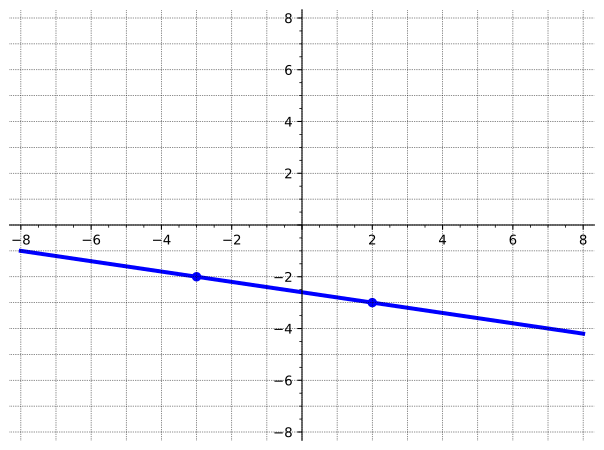
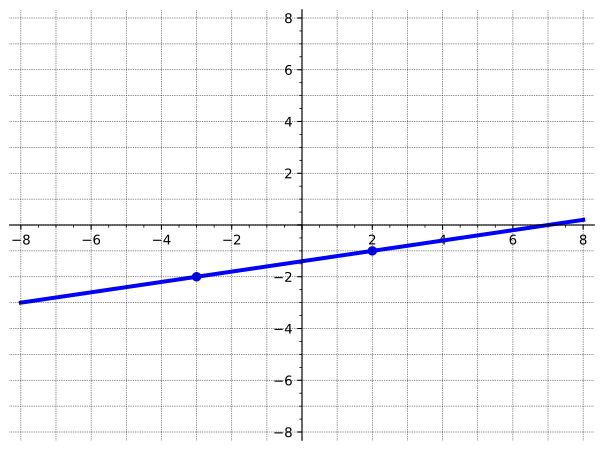
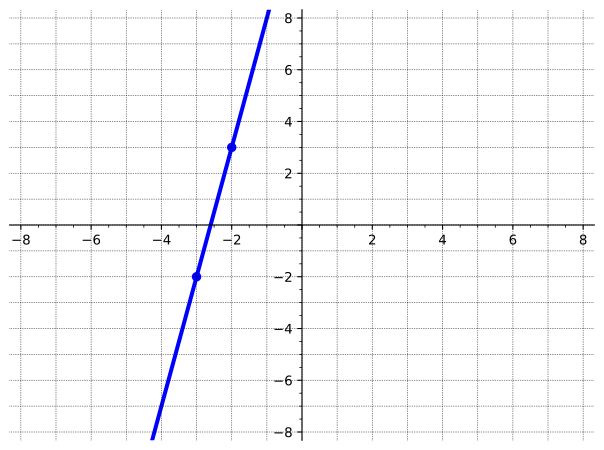
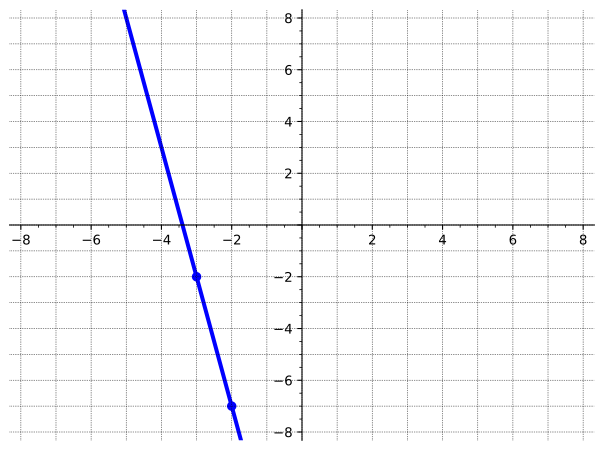
Activity 3.3.7 .
A line contains the point
\((-3,-2)\) and has slope
\(\dfrac{1}{5} \text{.}\) Which of the following is the graph of that line?
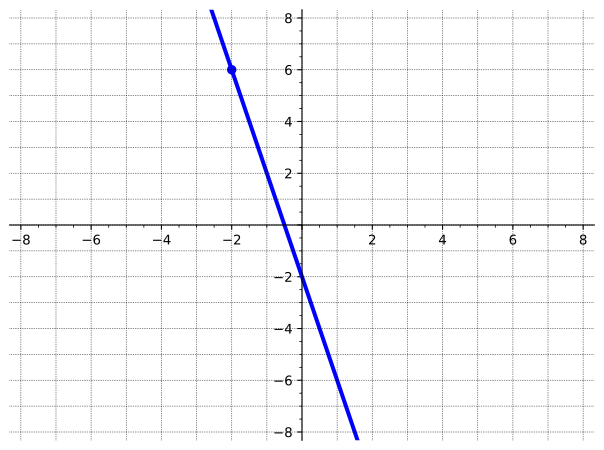
Activity 3.3.8 .
A line is given by the equation
\(y-6=-4(x+2)\text{.}\)
(a)
What form is the equation given in?
Standard form
Point-slope form
Slope-intercept form
The form it is in doesn’t have a name.
(b)
The form gives us one point right away. Which of the following is a point on the line?
\(\displaystyle (-2,-6)\)
\(\displaystyle (-2,6)\)
\(\displaystyle (2,-6)\)
\(\displaystyle (2,6)\)
(c)
Activity 3.3.9 .
Recall from
Definition 3.2.14 that the equation of a horizontal line has the form
\(y=k\) where
\(k\) is a constant and a vertical line has the form
\(x=h\) where
\(h\) is a constant.
(a)
Which type of line has a slope of zero?
(b)
Which type of line has an undefined slope?
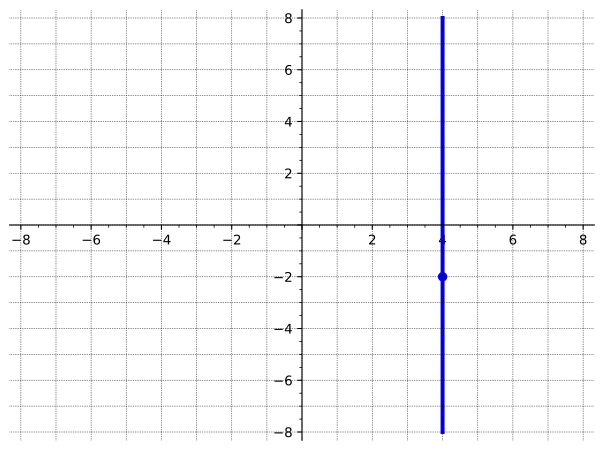
(c) Graph the vertical line that goes through the point
\((4,-2)\text{.}\)
(d)
What is the equation of the vertical line through the point \((4,-2)\text{?}\)
\(\displaystyle x=4\)
\(\displaystyle y=4\)
\(\displaystyle x=-2\)
\(\displaystyle y=-2\)
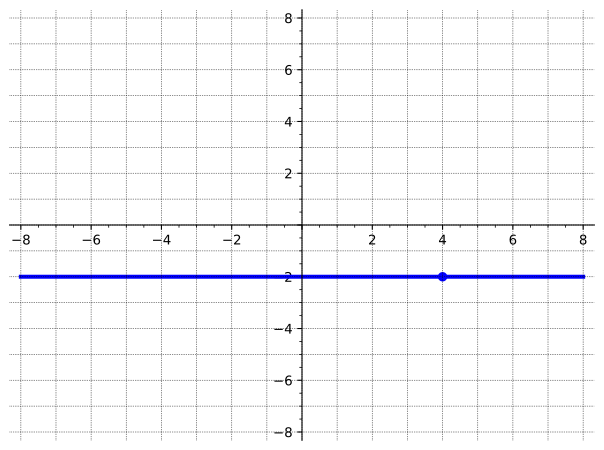
(e) Graph the horizontal line that goes through the point
\((4,-2)\text{.}\)
(f)
What is the equation of the horizontal line through the point \((4,-2)\text{?}\)
\(\displaystyle x=4\)
\(\displaystyle y=4\)
\(\displaystyle x=-2\)
\(\displaystyle y=-2\)
Activity 3.3.10 .
Graph each line described below.
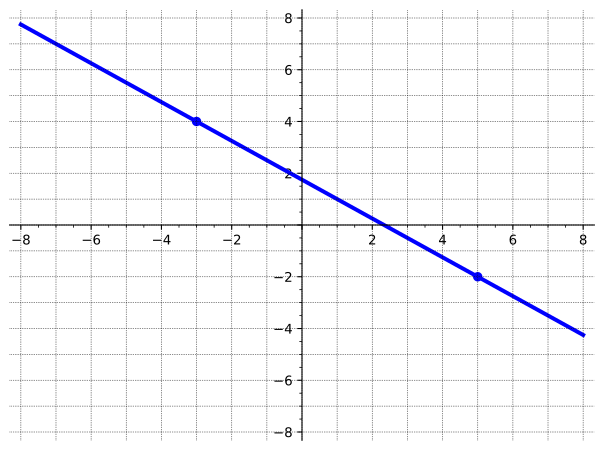
(a) The line containing the points
\((-3,4)\) and
\((5,-2)\text{.}\)
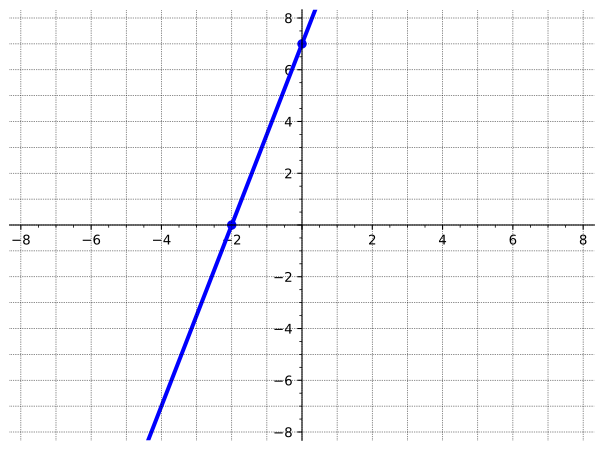
(b) The line whose
\(x\) -intercept is
\(-2\) and whose
\(y\) -intercept is
\(7\text{.}\)
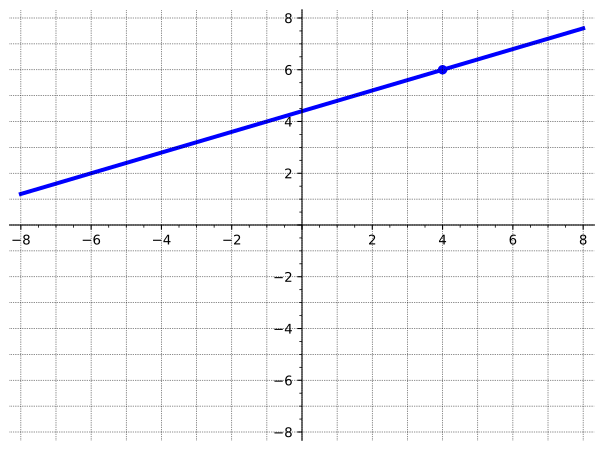
(c) The line whose slope is
\(\dfrac{2}{5}\) that goes through the point
\((4,6)\text{.}\)
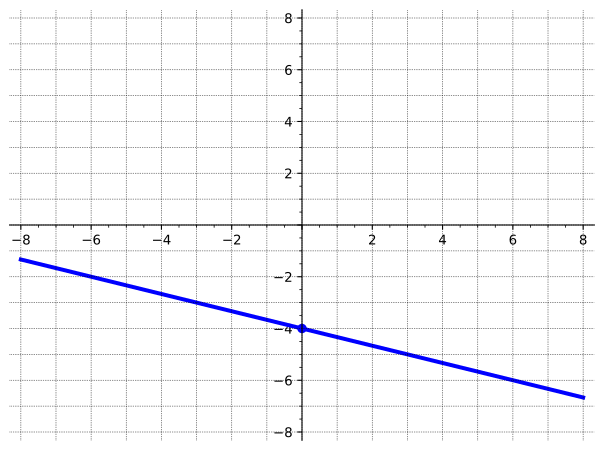
(d) The line whose slope is
\(-\dfrac{1}{3}\) and whose
\(y\) -intercept is
\(-4\text{.}\)
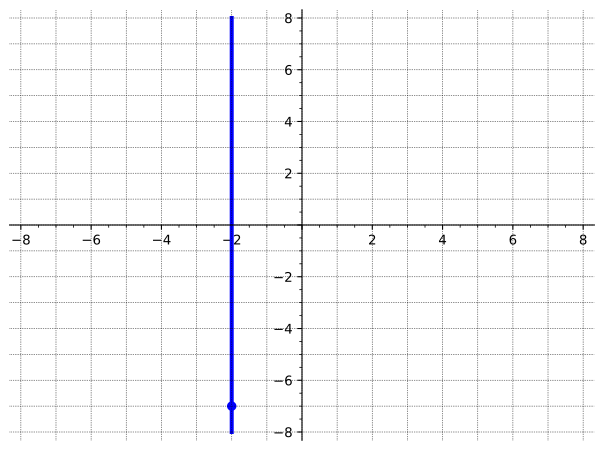
(e) The vertical line through the point
\((-2,-7)\text{.}\)
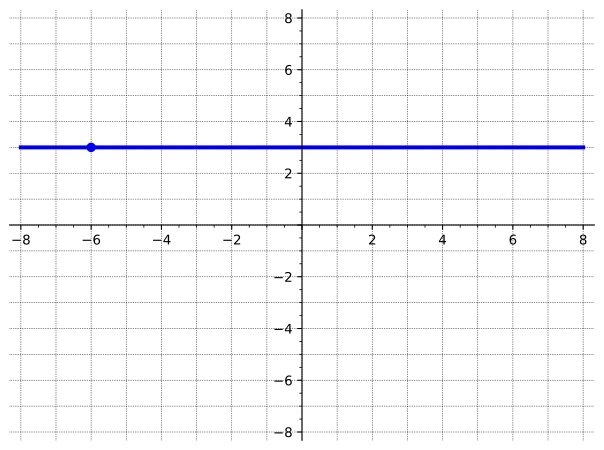
(f) The horizontal line through the point
\((-6,3)\text{.}\)
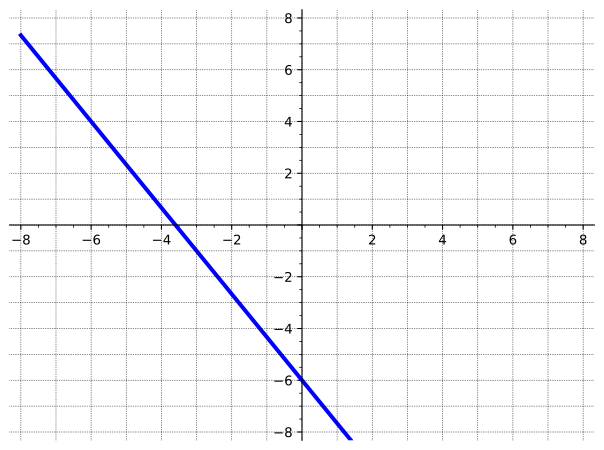
(g) The line with equation
\(y=-\dfrac{5}{3}x-6\text{.}\)
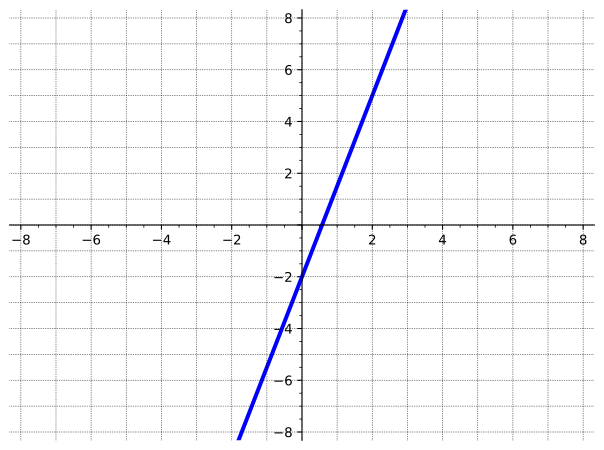
(h) The line with equation
\(y-5=\dfrac{7}{2}(x-2)\text{.}\)
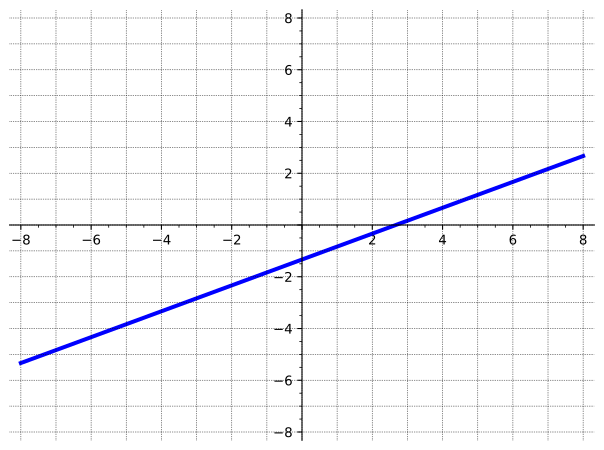
(i) The line with equation
\(3x-6y=8\text{.}\)
Subsection 3.3.2 Exercises